

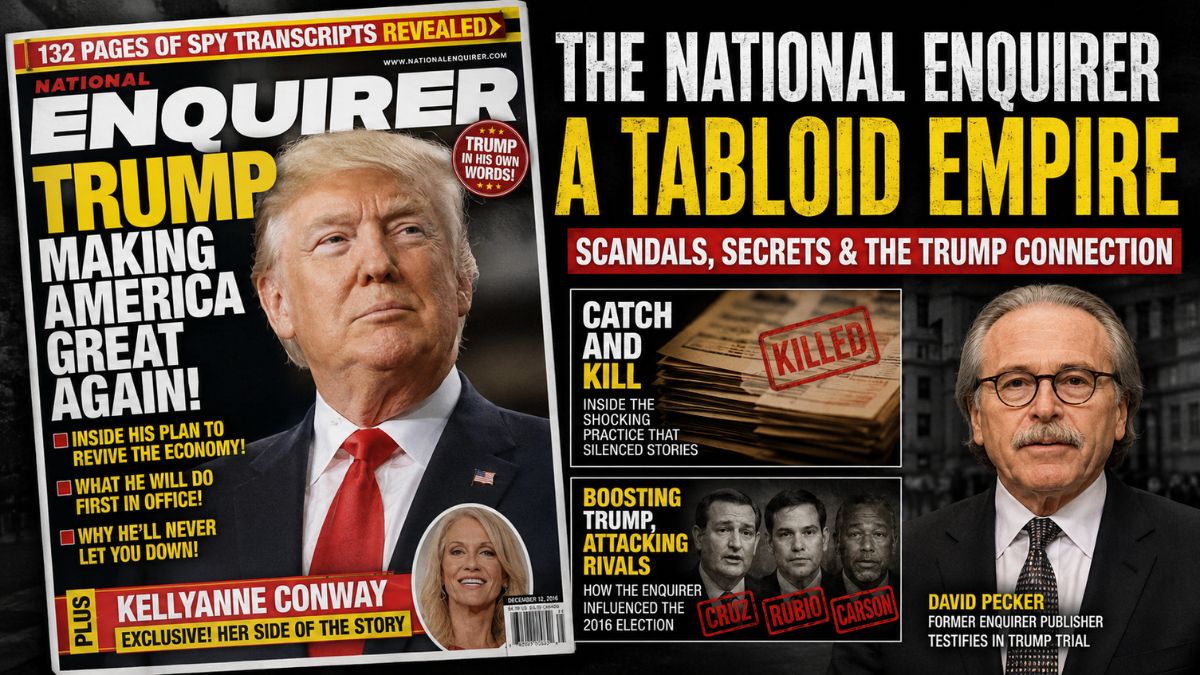
For decades, the National Enquirer dominated supermarket checkout lines across America. Its dramatic celebrity headlines, shocking political stories, and sensational exclusives made it one of the most recognizable tabloids in media history.
But in recent years, especially during the political rise of Donald Trump, the publication became deeply tied to controversies involving media ethics, political influence, “catch and kill” tactics, and misinformation.
What was once considered America’s ultimate gossip machine slowly transformed into a case study about the changing relationship between politics, celebrity culture, and tabloid journalism.
📰 The Rise of the National Enquirer
The Tabloid That Defined Checkout-Line Journalism
Long before social media and viral celebrity blogs, the National Enquirer mastered attention-grabbing journalism.
During the 1960s and 1970s, the tabloid became a fixture in:
- Grocery stores
- Supermarkets
- Convenience stores
Its formula was simple:
- Bold headlines
- Celebrity scandals
- Strange mysteries
- Emotional storytelling
Readers waiting in checkout lines were instantly drawn into stories about:
- UFO sightings
- Secret affairs
- Miraculous recoveries
- Hollywood scandals
Whether fully accurate or heavily exaggerated, the stories were rarely boring.
📸 The Golden Age of Tabloid Culture
Celebrity Obsession and Massive Sales
The Enquirer became especially famous for celebrity coverage.
Its reporters aggressively pursued:
- Hidden relationships
- Private scandals
- Exclusive photographs
- Behind-the-scenes Hollywood rumors
One of the tabloid’s most infamous moments came after the death of:
👉 Elvis Presley
The publication obtained and published a controversial image of Presley in his coffin. The issue reportedly sold millions of copies and became one of the biggest tabloid moments in American publishing history.
Breaking Stories Traditional Media Missed
Although mainstream journalists often mocked tabloids, the Enquirer occasionally broke legitimate major stories.
Notable examples included:
- Coverage involving Gary Hart
- Reporting on John Edwards scandals
- Celebrity affairs and political controversies
Some investigations were so impactful that the publication even received discussions surrounding prestigious journalism recognition.
🏛️ Donald Trump and the Enquirer Connection
Trump’s Long History With the Tabloid
Long before entering politics, Donald Trump was already deeply connected to tabloid culture.
In the 1980s and 1990s:
- Trump regularly appeared in celebrity gossip coverage
- His personal relationships became headline material
- He cultivated relationships with media executives
When David Pecker acquired the Enquirer in 1999, Trump reportedly congratulated him personally.
Over time, their relationship became increasingly significant.
The “Catch and Kill” Strategy Explained
One of the biggest controversies connected to the Enquirer involved a tactic known as:
👉 Catch and Kill
This involved:
- Purchasing exclusive rights to damaging stories
- Preventing those stories from ever being published
Critics argued the tactic was used to protect powerful individuals while manipulating public narratives.
The strategy became heavily discussed during legal proceedings connected to Trump’s 2016 presidential campaign.
⚖️ Media Ethics and Political Influence
David Pecker’s Court Testimony
Former publisher David Pecker later testified about arrangements allegedly designed to:
- Support Trump politically
- Suppress damaging stories
- Attack political opponents
The revelations shocked many observers because they blurred the line between:
- Journalism
- Political campaigning
- Corporate influence
Critics claimed the tabloid abandoned even its own sensationalist standards in favor of political loyalty.
Anti-Clinton Headlines and Campaign Influence
During the 2016 election cycle, the Enquirer published aggressive stories targeting:
👉 Hillary Clinton
Meanwhile, the publication frequently praised Trump with dramatic headlines portraying him as:
- Strong
- Healthy
- Presidential
- Victimized by opponents
These stories reached millions of readers in supermarkets and stores across the country.
🧠 Fake News Before the Social Media Explosion
Sensational Stories About Trump Rivals
According to former insiders, the Enquirer published outrageous allegations involving:
- Ted Cruz
- Marco Rubio
- Ben Carson
Some headlines included:
- Secret affairs
- Criminal allegations
- Drug rumors
- Conspiracy theories
Many claims lacked evidence but still gained public attention.
This era helped fuel larger conversations about:
- Disinformation
- Media manipulation
- Political propaganda
“Ground Zero” for Fake News?
Some former employees later described the Enquirer as an early example of what would eventually become known as:
👉 “Fake News”
The publication’s mix of:
- Emotional headlines
- Sensational accusations
- Celebrity-style political coverage
anticipated the digital misinformation environment that exploded during the social media era.
📉 Decline of the National Enquirer
Changing Media Habits
The internet dramatically changed tabloid journalism.
Readers increasingly turned to:
- Celebrity blogs
- Social media platforms
- YouTube commentary
- Entertainment websites
As a result, the Enquirer’s influence declined significantly.
Rise of TMZ and Digital Celebrity Media
Modern entertainment outlets like:
effectively replaced many traditional tabloid functions by offering:
- Faster reporting
- Viral video content
- Real-time celebrity updates
Digital media moved much quicker than weekly print tabloids could manage.
The Jeff Bezos Controversy
In 2019, the Enquirer became involved in another major controversy involving:
👉 Jeff Bezos
The publication published private messages allegedly connected to Bezos’ personal life.
The situation escalated after Bezos accused the company of attempted blackmail regarding unpublished photographs.
The scandal further damaged the Enquirer’s reputation.
🏚️ From Media Giant to Cultural Relic
Declining Sales and Public Relevance
By the 2020s, sales numbers had dramatically collapsed.
Several factors contributed:
- Social media dominance
- Loss of credibility
- Competition from digital platforms
- Political controversies
What was once one of America’s most influential tabloids became a shadow of its former self.
The Legacy of the National Enquirer
Despite criticism, the Enquirer undeniably changed media culture forever.
Its influence can still be seen today in:
- Celebrity gossip websites
- Clickbait headlines
- Viral scandal reporting
- Political tabloid-style coverage
The publication pioneered forms of sensational storytelling that later evolved into modern internet media culture.
📺 Tabloid Journalism’s Lasting Impact
What the Enquirer Era Taught the Media World
The rise and fall of the National Enquirer highlights several important lessons:
1. Attention Sells
Sensational headlines remain powerful.
2. Celebrity and Politics Now Overlap
Modern political figures increasingly operate like entertainment celebrities.
3. Credibility Matters
Once public trust disappears, rebuilding it becomes difficult.
4. Digital Media Changed Everything
The internet transformed how scandals spread and how audiences consume information.
Final Thoughts
The story of the National Enquirer is more than the story of a gossip publication.
It reflects:
- America’s fascination with celebrity culture
- The evolution of political media
- The rise of misinformation
- The transformation of journalism in the digital age
For decades, the Enquirer shaped tabloid culture and influenced millions of readers. But its deep involvement in political controversies—especially surrounding Donald Trump—ultimately changed how many people viewed the publication forever.
Today, the Enquirer survives mostly as a reminder of an earlier media era—one where supermarket headlines held enormous cultural power.