

The world of technology is expanding at an accelerated rate. Thus, it is important for businesses to stay on top of trends and stay updated with the latest architecture. One of the latest trends that has sent ripples across the industry, especially in the niche of software architecture, is SOA OS23. With quick advancements revolutionizing industries on a daily basis, it is vital to understand what SOA OS23 is and why it is so significant.
Just think about a world where software systems communicate efficiently, improving efficiency and minimizing complexity. SOA provides just that—an advanced framework that enables businesses to adjust quickly while providing powerful solutions personalized for modern demands. As we move further in this blog, you will understand its benefits, revolutionary industrial impact, challenges that come up during adoption, right practices to ensure during implementation, etc.
So, let us delve deep into OS23 and understand how it is redefining innovation in the world of software architecture.
[What is SOA?]
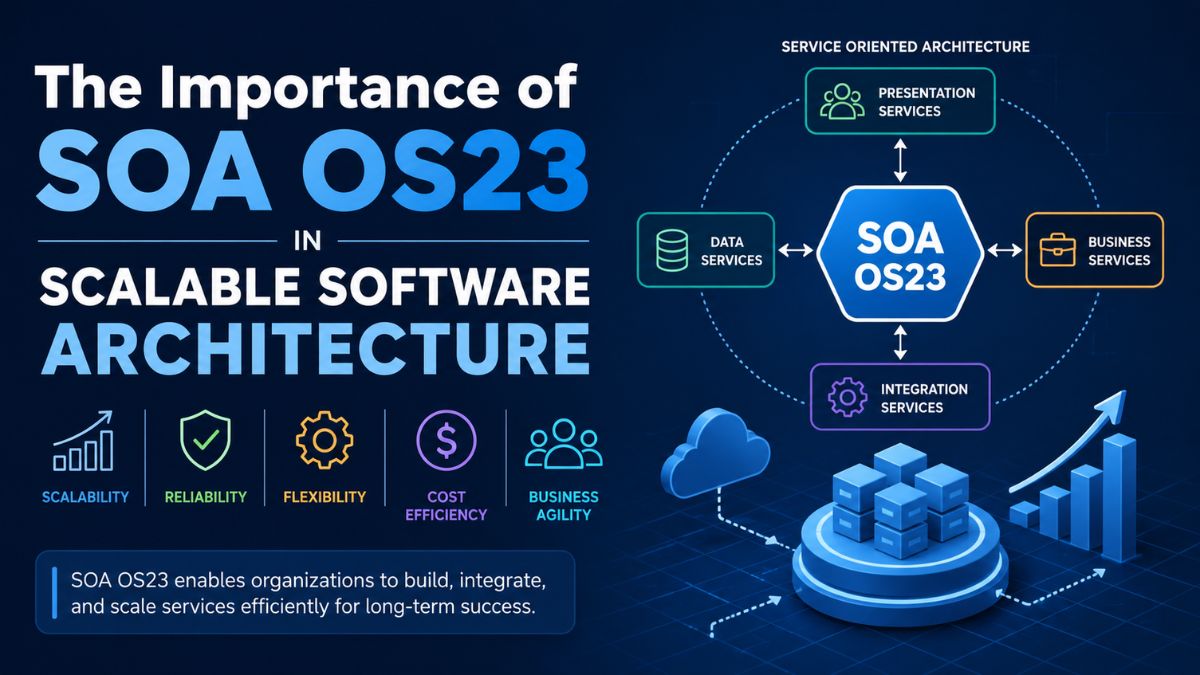
Service-Oriented Architecture (SOA) is a software design approach where services are provided to other components by application components, through a communication protocol over a network. It promotes reusability, scalability, and easier integration of complex applications.
SOA allows different services to communicate with each other regardless of the underlying platform or programming language. This makes it ideal for large-scale enterprise systems and multi-cloud strategies.
🚀 Introducing SOA OS23
SOA OS23 is the latest operating environment or platform update (hypothetically) built to optimize the deployment and management of SOA-based applications and services. It acts as a powerful middleware layer that streamlines service orchestration, governance, and real-time analytics.
Here are the standout features:
🧠 1. Intelligent Service Discovery
SOA OS23 (https://soaos23.co.uk) integrates AI-driven service discovery, enabling systems to automatically detect and integrate with new services without manual configuration. This reduces integration time and ensures real-time adaptability.
🔐 2. Enhanced Security & Compliance
With growing concerns around data privacy and security, SOA OS23 includes built-in compliance tools, encryption modules, and automated policy enforcement to meet international standards like GDPR, HIPAA, and ISO/IEC 27001.
⚙️ 3. Cloud-Native & Container Support
OS23 supports Kubernetes-native deployments, making it ideal for hybrid cloud or multi-cloud architectures. Its compatibility with Docker and Helm Charts simplifies the deployment and scaling of services.
📈 4. Real-Time Monitoring and Analytics
The platform provides advanced monitoring dashboards, SLAs tracking, and root-cause analytics. This helps operations teams reduce downtime and proactively optimize performance.
🔄 5. Low-Code Orchestration Engine
SOA OS23 introduces a visual orchestration layer where developers and business analysts can drag and drop services to define business workflows, reducing dependency on deep coding knowledge.
🤝 6. Seamless Legacy System Integration
For enterprises still relying on legacy systems, SOA OS23 offers pre-built adapters and data transformation pipelines to bridge old and new technologies effortlessly.
What Are the Major Challenges That Come Up When Implementing SOA OS23?
The implementation process of SOA OS23 brings a fresh set of challenges that are important for the businesses to solve. One of the important challenges is the need for decent investment in the initial stages. Investment is a requirement to deploy the infrastructure and train the staff. Switching to this architecture might also involve a substantial number of resources.
Another challenge occurs when you wish to incorporate legacy platforms with modern services. There are numerous organizations that find it difficult to close this gap between present demands and outdated technologies. This leads to possible disruptions. Establishing proper guidelines is also crucial, as without them, teams can face challenges while handling services. There are also a few cultural resistances within the businesses that prove to be a major hurdle. Employees become used to conventional methods and shy away from adopting new approaches.
Apart from that, there are also ongoing challenges with respect to ensuring security across distributed services. With more interaction among the components, the number of vulnerabilities can increase if they are not effectively addressed from the beginning.
What Are the Right Practices for Introducing SOA OS23?
- Focus on Vision: If you are planning to establish SOA OS23 within your organization, you must start with a neat vision. You must determine your goals and recognize specific requirements within your organization. Clarity in vision will then further guide you in every decision you take.
- Proper Internal Communication: In the next step, you must make sure that there is smooth communication between all your teams. Better collaboration leads to innovation and facilitates seamless integration of services. Ensure regular feedback loops to ascertain an agile environment that quickly adjusts to changes.
- Team Training: Focus on investing in your team training. Getting them aligned with SOA fundamentals is vital for success. If your team is equipped with the best knowledge, they will be capable of resolving core challenges.
- Adopt Modern Tools and Techniques: Trust only the modern tools, techniques, and frameworks specialized for OS23 adoption. Adopting modern tools and frameworks can simplify processes and improve efficiency.
- Continuous Performance Monitoring: Make sure that you are continuously tracking performance after implementation. Consistent assessments aid you in recognizing improvement areas and ensure enhancement over a course of time.
What Are the Applications of SOA OS23?
This architecture standard has a range of applications as explained in the following points-
- Integration of Enterprise Application: Organizations still depending on old platforms can adopt this architecture standard to ensure a fully integrated ecosystem. Services will then be able to communicate with one another without having to dispose of any system.
- Public Sector IT and E-Governance: Various agencies in the country can leverage this approach to establish connections between various public services. In this architecture, not only platforms can communicate and share data in a confidential manner, but different agencies also get the same playbook to follow.
- Healthcare Platforms: Clinics and hospitals can also smoothly and safely exchange patient data. SOA OS23 is vital for privacy of patient data and making sure that healthcare providers remain aligned with the rules.
- Banking and Financial Services: Banks can consolidate modules on OS23 to build systems that are robust, secure, easily modifiable, etc. The architecture can help banks respond to customer requests and new transactions.
- Telecommunication Networks: Telecommunication networks can operate network gear, billing, and customer services as individual but linked services. Through this approach, they can make sure that all the systems remain fast and lean while ensuring robust communication with others.
Conclusion
The newly developed SOA OS23 has garnered visibility in the domain of software architecture. Its powerful features and user-convenient interface allow businesses to effectively simplify operations. By understanding main functionalities, businesses can leverage the architecture standard to ensure innovation and boost productivity. The blog explores SOA OS23 from scratch, exploring its basics, how it works, advantages, use-cases, role in transforming software architecture, etc.